
Film Pot: Brick by Brick, 12&13 June, Amsterdam, OT301
This Film Program takes place as part of the Public Program of the exhibition Building a House without Bricks in Amsterdam. Below you can see the table and the detailed information of the films
12 June 2026, 14:00–19:00
13 June 2026, 16:00–19:00
Film Pot is a shared digital space where filmmakers contribute works into a common pool: a living archive built on trust, circulation, and collective use. It grows from the experience of translocal communities, the understanding that moving images can carry context across borders, and that learning from each other’s contexts and ways of seeing the world is itself a form of being together.
This screening brings together a selection of films from this shared space: works created in the different localities where our ecosystems are rooted, including Mexico, Lombok, and Makassar (Indonesia), as well as Belgium and the Netherlands, followed by a conversation with some of the filmmakers present. The films do not share a single theme so much as a shared condition: they travel and make a place for encounter where physical presence was not possible.
This programme is divided into three bricks — The Fire Travels, What the Ground Holds, and Home Screen: Thresholds, — where different localities, memories, and conditions of struggle enter into conversation.
The Films are programmed by the Translocal Archive / Documentary Working Group of Lumbung Practice.
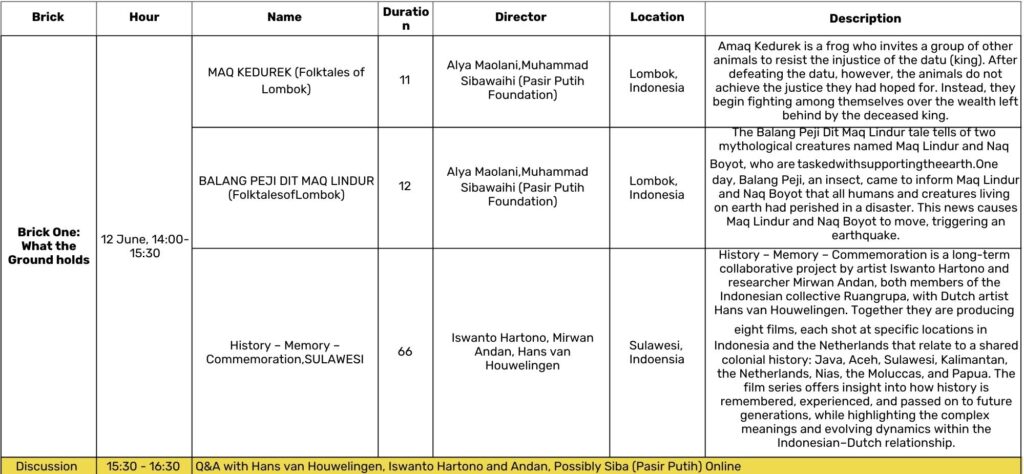
Brick One: What the Ground holds (12 June, 14:00 – 16:30)
MAQ KEDUREK
Alya Maolani, Muhammad Sibawaihi (Pasir Putih Foundation) (2023) – 11 Minutes – Lombok, Indonesia
“Amaq Kedurek is a frog who invites a group of other animals to resist the injustice of the datu (king). After defeating the datu, however, the animals do not achieve the justice they had hoped for. Instead, they begin fighting among themselves over the wealth left behind by the deceased king.
Amaq Kedurek is a folktale originating from the Gangga District. The film tells the story of the resistance led by Amaq Kedurek (the frog) and his companions against the tyranny of the datu (king). This story is retold by Amiq Pardim from Telaga Maluku Hamlet, Rempek Village, Gangga District.”
BALANG PEJI DIT MAQ LINDUR
Alya Maolani, Muhammad Sibawaihi (Pasir Putih Foundation) (2023) – 12 Minutes – Lombok, Indonesia
“The Balang Peji Dit Maq Lindur tale tells of two mythological creatures named Maq Lindur and Naq Boyot, who are tasked with supporting the earth. One day, Balang Peji, an insect, came to inform Maq Lindur and Naq Boyot that all humans and creatures living on earth had perished in a disaster. This news causes Maq Lindur and Naq Boyot to move, triggering an earthquake.
Balang Peji Dit Maq Lindur is a waran originating from Bayan Subdistrict. This waran explains the origin of the Bayan people’s terms for earthquakes: Lindur (daytime earthquake) and Boyot (nighttime earthquake). This waran was retold by Mr. Remadi, a resident of Teluk Hamlet, Sukadana Village, Bayan Subdistrict.”
History - Memory – Commemoration / SULAWESI
Iswanto Hartono, Mirwan Andan, Hans van Houwelingen (2026) – 66 Minutes – Sulawesi, Indonesia
History – Memory – Commemoration is a long-term collaborative project by artist Iswanto Hartono and researcher Mirwan Andan, both members of the Indonesian collective Ruangrupa, with Dutch artist Hans van Houwelingen. Together they are producing eight films, each shot at specific locations in Indonesia and the Netherlands that relate to a shared colonial history.
SULAWESI is the third work in this project. This film was recorded in Sulawesi (Makassar, Barru, Pare-Pare, Palopo) at the end of February 2025. Focusing on a future of independence and freedom few memorials have been erected to commemorate the suffering and misery of the colonial past. This film is recorded in Sulawesi and shows people’s remembrance and need for specific memorials to commemorate the victims of the atrocities of the Dutch captain Raymond Westerling, of the Special Troups of the Dutch military, during the independence war in 1946/47. This work reflect on the numerous large and impressive memorials in Sulawesi to commemorate the victims of Raymond Westerling, and its echo in the present time.
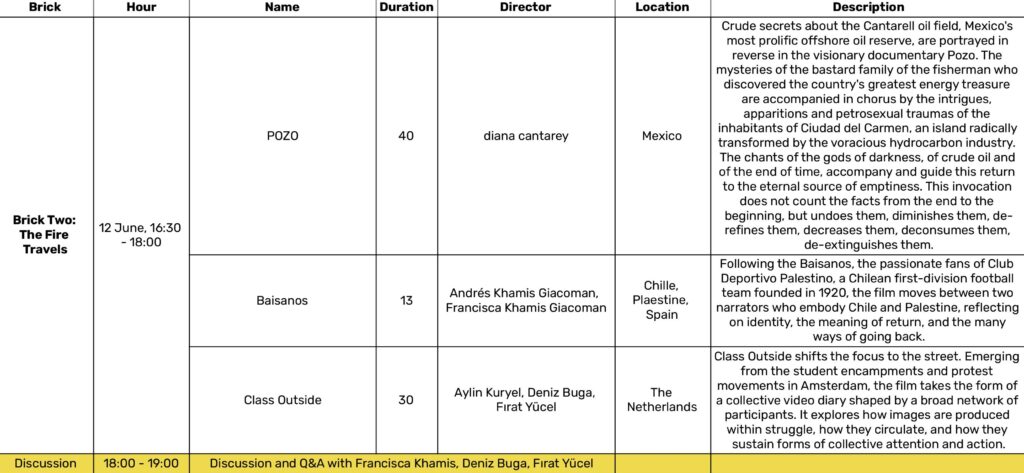
Brick Two: The Fire Travels (12 June, 16:30 – 19:00)
POZO
diana cantarey (2024) – 40 Minutes – Mexico
Crude secrets about the Cantarell oil field, Mexico’s most prolific offshore oil reserve, are portrayed in reverse in the visionary documentary Pozo. The mysteries of the bastard family of the fisherman who discovered the country’s greatest energy treasure are accompanied in chorus by the intrigues, apparitions and petrosexual traumas of the inhabitants of Ciudad del Carmen, an island radically transformed by the voracious hydrocarbon industry. The chants of the gods of darkness, of crude oil and of the end of time, accompany and guide this return to the eternal source of emptiness. This invocation does not count the facts from the end to the beginning, but undoes them, diminishes them, de-refines them, decreases them, deconsumes them, de-extinguishes them.
Baisanos
Andrés Khamis Giacoman, Francisca Khamis Giacoman (2025) – 13 Minutes – Chile, Palestine, Spain
Following the Baisanos, the passionate fans of Club Deportivo Palestino, a Chilean first-division football team founded in 1920, the film moves between two narrators who embody Chile and Palestine, reflecting on identity, the meaning of return, and the many ways of going back.
Class Outside
Aylin Kuryel, Deniz Buga, Fırat Yücel (2025) – 30 Minutes – The Netherlands
Class Outside shifts the focus to the street. Emerging from the student encampments and protest movements in Amsterdam, the film takes the form of a collective video diary shaped by a broad network of participants. It explores how images are produced within struggle, how they circulate, and how they sustain forms of collective attention and action.
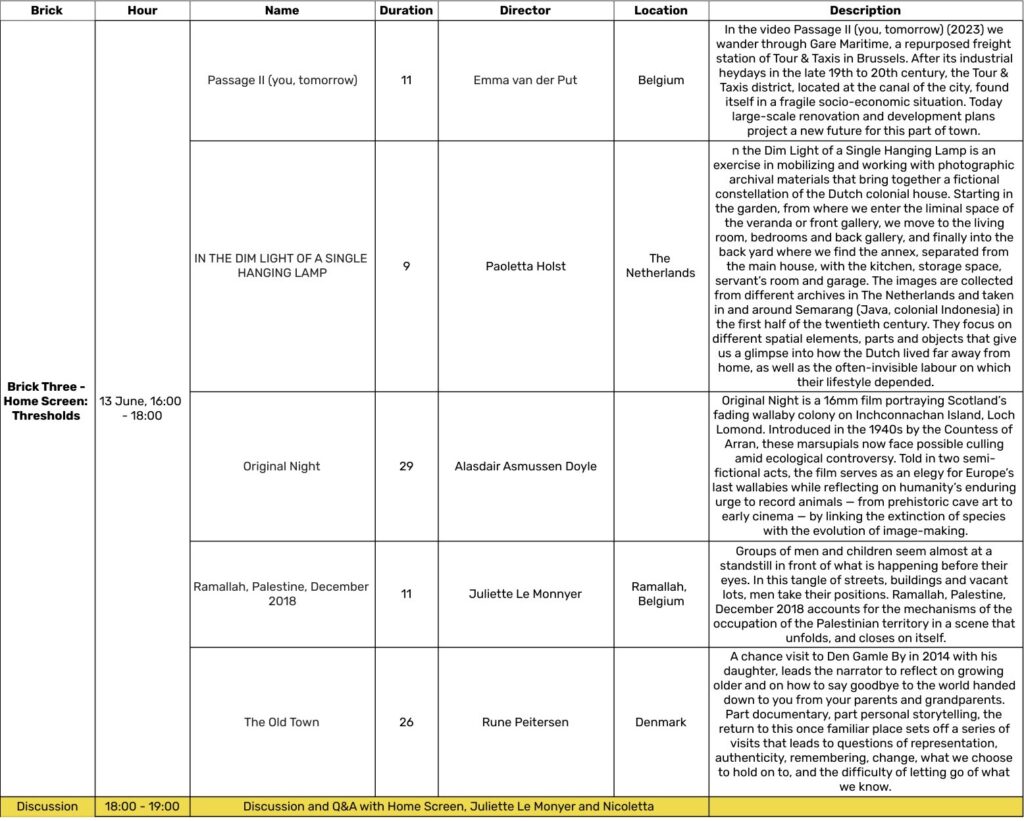
Brick Three – Home Screen: Thresholds (13 June, 16:00 – 18:30)
In the Dim Light of a Single Hanging Lamp
Paoletta Holst (2024) – 9 Minutes – The Netherlands
The video work ‘In the Dim Light of a Single Hanging Lamp’ is an exercise in mobilizing and working with photographic archival materials that assemble a fictional constellation of a Dutch colonial house. The images were collected from various archives in the Netherlands and were taken in and around Semarang (Java, colonial Indonesia) during the first half of the twentieth century. Moving from room to room, the film focuses on different spatial elements, architectural details, and objects that offer a glimpse into how the Dutch lived far from home, while also revealing the colonial hierarchies and often invisible labour performed by Indigenous servants upon which their lifestyle depended.
Ramallah, Palestine, December 2018
Juliette le Monnyer (2025) – 11 Minutes – Belgium
Groups of men and children seem almost at a standstill in front of what is happening before their eyes. In this tangle of streets, buildings and vacant lots, men take their positions. Ramallah, Palestine, December 2018 accounts for the mechanisms of the occupation of the Palestinian territory in a scene that unfolds, and closes on itself.
The Old Town
Rune Peitersen (2024) – 26 Minutes – Denmark
A chance visit to Den Gamle By in 2014 with his daughter, leads the narrator to reflect on growing older and on how to say goodbye to the world handed down to you from your parents and grandparents. Part documentary, part personal storytelling, the return to this once familiar place sets off a series of visits that leads to questions of representation, authenticity, remembering, change, what we choose to hold on to, and the difficulty of letting go of what we know.
Passage II (you, tomorrow)
Emma van der Put (2023) -11 Minutes – Belgium
In the video Passage II (you, tomorrow) (2023) we wander through Gare Maritime, a repurposed freight station of Tour & Taxis in Brussels. After its industrial heydays in the late 19th to 20th century, the Tour & Taxis district, located at the canal of the city, found itself in a fragile socio-economic situation. Today large-scale renovation and development plans project a new future for this part of town.
Original Night
Alasdair Asmussen Doyle (2025) – 29 Minutes – Belgium
Original Night is a 16mm film portraying Scotland’s fading wallaby colony on Inchconnachan Island, Loch Lomond. Introduced in the 1940s by the Countess of Arran, these marsupials now face possible culling amid ecological controversy. Told in two semi-fictional acts, the film serves as an elegy for Europe’s last wallabies while reflecting on humanity’s enduring urge to record animals — from prehistoric cave art to early cinema — by linking the extinction of species with the evolution of image-making.